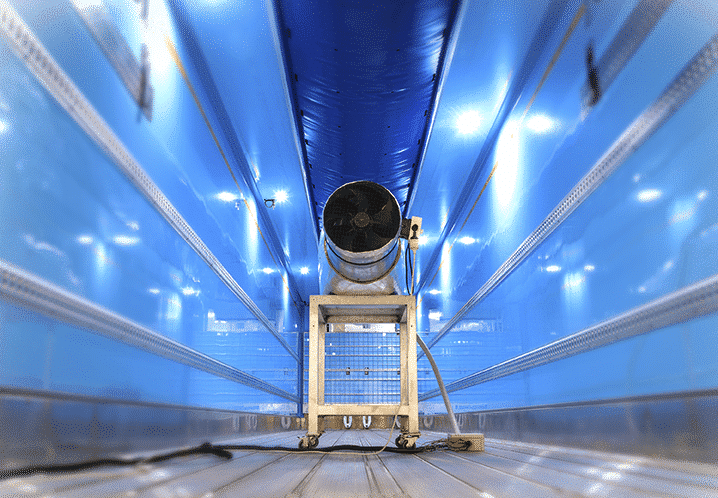
Field testing provides essential context, but it’s rarely stable.
Environmental conditions change, operating practices vary, and multiple variables often shift at once.
When results diverge from expectations, determining the cause can be difficult.
This introduces uncertainty into decision-making.
Changes may be implemented without clarity on whether observed behaviour is repeatable, environment-driven, or configuration-specific.
We isolate variables to reveal hidden insights.
Controlled testing environments exist to deliberately isolate and manage variables.
By stabilising temperature, humidity, load, and operating conditions, or adjusting them in a controlled manner, system behaviour can be observed under defined scenarios. This supports repeatable observation, meaningful comparison, and clearer distinction between environmental influence and system response.
Some behaviours only emerge under sustained operation or prolonged environmental stress. Controlled testing allows these behaviours to be observed over durations that are difficult to replicate reliably in the field.
Applications
Investigating unexplained behaviour
Where field performance is intermittent, inconsistent, or difficult to explain, controlled testing supports structured investigation under stable conditions.
Evaluating design or configuration changes
Testing under consistent conditions supports comparison against known baselines and identification of unintended effects before wider deployment.
Comparing and assessing alternatives
Controlled environments provide a neutral basis for comparing components, configurations, or operating strategies without the confounding effects of variable field conditions.
Assessing endurance under extended operation
Long-duration testing enables observation of stability, control behaviour, and response under sustained environmental exposure.
Supporting technical and commercial decisions
Testing supports internal engineering reviews, design development prioritisation, supplier or solution evaluation and investment decisions.
Field testing answers: What is happening in practice?
Controlled testing helps answer: Why is it happening under defined conditions?
Together, they support informed understanding and decision-making.