
SuperCool Competitions Department Events and Milestones
SuperCool Competitions Department completed assembly of both Yamaha 125cc race bikes. In preparation for the forthcoming Queensland Historic Road Racing Championships, one bike was chosen for the race. It was time for a dyno test.
Both 125cc machines were completed and ready for racing in June 2025, and it was time to decide which bike to race in the forthcoming Queensland Historic Road Racing Championships in August, or whether both bikes would be raced.
Due to the unique history of the 1973 TA125 machine, which is essentially still new and has never been raced, a significant decision was made to quarantine this bike for display and maintain it for the benefit of future admirers. It is a wonderful reference machine to enable future enthusiasts to know exactly how Yamaha presented these bikes as they left the production line in 1973.
Our other bike is a 1972 Yamaha AS3 Genuine Tuning Kit (GYT) machine which is the forerunner platform to the TA125 models released in 1973. Road racing customers would buy a Yamaha AS3 road bike and fit the GYT kit for racing. The kit consisted of engine cylinders, heads pistons and rings, expansion chambers, magneto and ignition system, carburetors, conrods, big-end bearings, clutch plates, gear change lever, clip on bars, racing twist grip and tachometer. In full GYT trim, the engine power increased from 15 to 24 hp at 12500 rpm.
Our SuperTest Dyno was not quite ready, and we were lacking in experience for testing two stroke engines which is a skill we will eventually master, but in the meantime, we contacted Grant Jordan at Motorcycle Dyno and Garage (MDG) for assistance. We are glad we did, the experience and wealth of knowledge for two stroke racing Grant and his team possess is invaluable.
Before placing the bike on the MDG dyno we estimated the jet size at #200 for ambient conditions 23-28 degrees dry bulb temperature (DBT) and 40-60% relative humidity (RH).
Grant is a true professional with a clear and concise plan for each bike he tests on his dyno. He applied five key steps for our machine;
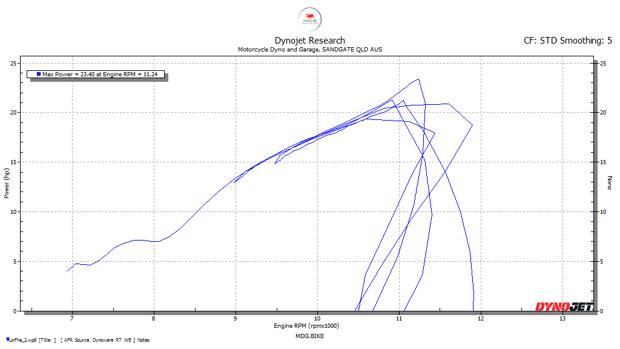
During step 2 the left-hand EGT was colder by 50°F, therefore, the carburetor slide was adjusted accordingly – EGT readings were equal at between 380-400°F at 4000 rpm. The power run was performed through to third gear with the bike tachometer reading just over 12000 rpm in each gear. The dyno data result was 23.40 hp at 11240 rpm. This revealed the bike tachometer differs by 800-1000 rpm from the actual rpm as measured electronically from the ignition which confirms the motor is close to producing its maximum rated power of 24 hp at 12500 rpm.
Find the best HVAC&R products for your mobile, industrial or commercial needs.